GLNBench
Benchmarking Robustness Strategies for Graph Neural Networks under Noise
A benchmarking framework for systematically evaluating GNN robustness strategies under label noise. It benchmarks 12 robustness methods plus a Standard baseline under standardized conditions across 24 datasets with 9 noise types, enabling fair and reproducible comparisons. The framework measures classification performance, oversmoothing behaviour, and computational cost in a unified pipeline.
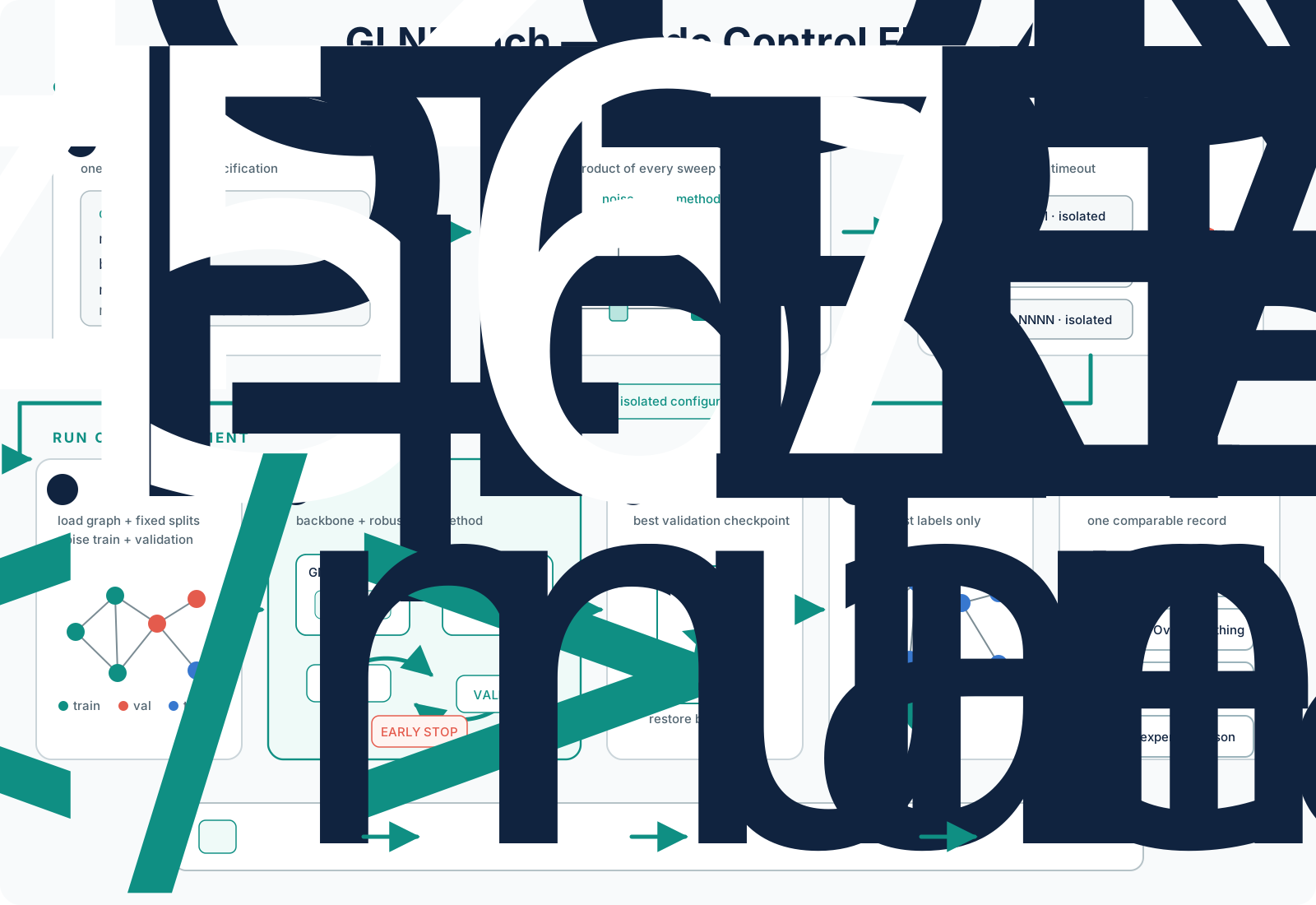
Table of Contents
- Quick Start
- Installation
- How to Run
- Configuration
- Robustness Methods
- Batch Processing
- Transductive and Inductive Learning
- Evaluation Metrics
- Output and Results
- Adding New Methods
- Testing
- Project Structure
- Author
Quick Start
Browser experiment builder
Use the privacy-preserving GLNBench Experiment Builder
to select a supported dataset, noise model, backbone, robustness method, and
training settings. It validates known compatibility constraints and produces a
downloadable config.yaml, exact run commands, and shareable configuration
links. The builder runs entirely in the browser and does not submit experiments
or configuration data to a server.
For a zero-setup, CPU-friendly demonstration, open
examples/quickstart.ipynb in Google Colab. Full
benchmark sweeps should still be run in a controlled local, server, or cluster
environment. The notebook supports Colab’s Python 3.12 runtime through
requirements-colab.txt, preserving Colab’s preinstalled PyTorch build. This
quickstart environment is for demonstration; use the Python 3.10/3.11 pinned
environment below when reproducing benchmark results.
# 1. Install dependencies
python3 -m pip install -r requirements.txt
# For GPU (CUDA 11.8), run setup.sh instead

# 2. Edit config.yaml to set dataset, noise, method, etc.

# 3. Run the benchmark
python3 main.py -c config.yaml

# Results are saved to results/<experiment_dir>/experiment.json
Installation
CPU:
python3 -m pip install -r requirements.txt
GPU (CUDA 11.8):
./setup.sh
This installs PyTorch 2.2.1, PyTorch Geometric, and all dependencies.
The pinned release environment supports Python 3.10 and 3.11. On macOS, use ./setup_macos.sh. The required torch-scatter and torch-sparse sampler wheels are installed from PyG’s matching wheel index; further compiled PyG extensions are optional.
Dependencies: PyTorch, PyTorch Geometric, NumPy, SciPy, scikit-learn, networkx, pandas, cleanlab, matplotlib, codecarbon, PyYAML, requests, and pytest.
How to Run
1. Automatic Benchmarking — main.py
The primary entry point. Runs multi-run sweeps with automatic incremental execution, checkpointing, and aggregated statistics.
python3 main.py -c config.yaml
| Flag | Default | Description |
|---|---|---|
-c, --config |
config.yaml |
Path to YAML configuration file |
--num-runs |
from config or 5 | Number of runs per configuration |
--force |
off | Re-run all experiments, ignore completed runs |
--eval-only |
off | Skip training, evaluate from saved checkpoints |
--no-checkpoint |
off | Disable saving model checkpoints |
Incremental execution: Only missing runs are executed. Completed runs are detected from run_N/training_log.json. Increasing --num-runs from 5 to 10 executes only runs 6-10.
# Start with 2 runs
python3 main.py -c config.yaml --num-runs 2

# Later, bump to 5 -- only runs 3-5 execute
python3 main.py -c config.yaml --num-runs 5

# Force full re-run
python3 main.py -c config.yaml --num-runs 5 --force

# Re-evaluate from checkpoints without training
python3 main.py -c config.yaml --eval-only
2. Parallel Single Run — main_multithreading.py
Runs multiple methods in parallel with the same seed for quick comparison. Reads all non-method settings from config.yaml directly.
python main_multithreading.py -m standard nrgnn cr_gnn -r 1
| Flag | Default | Description |
|---|---|---|
-m, --methods |
standard cr_gnn nrgnn | Methods to run (max 4) |
-r, --run-id |
1 | Fixed run ID (determines seed) |
--no-checkpoint |
off | Disable checkpointing |
--eval-only |
off | Evaluate from saved checkpoints |
--checkpoint-dir |
checkpoints |
Checkpoint directory |
Workers: 2 parallel workers on GPU, 4 on CPU (auto-detected).
3. Programmatic API
import yaml
from util.experiment import run_experiment

with open("config.yaml", "r") as f:
    config = yaml.safe_load(f)

# Single experiment run
result = run_experiment(config, run_id=1)

print(f"Accuracy: {result['test_cls']['accuracy']:.4f}")
print(f"F1 Score: {result['test_cls']['f1']:.4f}")

# With checkpointing
result = run_experiment(config, run_id=1, checkpoint_path="best.pt", run_dir="run_1")

# Eval-only from checkpoint
result = run_experiment(config, run_id=1, checkpoint_path="best.pt", eval_only=True)
Configuration
All experiment settings are specified in a YAML file. A minimal example:
seed: 42
device: cpu          # cpu or cuda
num_runs: 5

dataset:
  name: cora
  root: data

noise:
  type: uniform
  rate: 0.2
  seed: 42

model:
  name: gcn
  hidden_channels: 16
  n_layers: 2
  dropout: 0.5

training:
  method: standard
  lr: 0.001
  weight_decay: 5e-4
  epochs: 200
  patience: 20
  # mode: inductive        # optional: transductive (default) or inductive
  # batch_size: 512        # optional: enables mini-batch processing
  # sampler: neighbor      # optional: neighbor, cluster, graphsaint, random_node
  # sampler_params:        # optional: sampler-specific parameters
  #   num_neighbors: [15, 10]
General Settings
| Parameter | Description |
|---|---|
seed |
Base seed for reproducibility. Model initialization and generated splits use seed + 100 * run_id. |
device |
cpu or cuda. Falls back to CPU if CUDA is unavailable. |
num_runs |
Number of independent runs per configuration (default: 5). |
Noise uses its own stream: noise.seed + 10 * run_id.
Dataset
| Parameter | Description |
|---|---|
name |
Dataset name (see list below) |
root |
Directory for dataset storage/download (default: data) |
normalize |
Row-normalize node features via NormalizeFeatures (default: true). Set to false for heterophilous datasets (e.g. roman-empire) where normalization can hurt. |
24 supported datasets:
| Family | Datasets |
|---|---|
| Planetoid | cora, citeseer, pubmed |
| Heterophilous | amazon-ratings, tolokers, roman-empire, minesweeper, questions |
| Citation | dblp |
| Amazon | amazon-computers, amazon-photo |
| Social | blogcatalog, flickr |
| GraphLAND (Zenodo) | hm-categories, pokec-regions, web-topics, tolokers-2, city-reviews, artnet-exp, web-fraud |
| GNN Benchmark | pattern, cluster |
| LRGB | pascalvoc-sp, coco-sp |
Datasets are automatically downloaded on first use. GraphLAND datasets are fetched from Zenodo. LRGB datasets are merged into a single graph with global node masks.
Train/val/test splits: If the dataset provides predefined splits, those are used. Otherwise, random splits are generated (80/10/10 by default) with a deterministic seed.
Noise
Label noise is injected into training and validation labels. Test labels remain clean (ground truth for final evaluation). This reflects real-world conditions where noisy annotations affect all labeled data, including the validation set used for early stopping.
Noise is sampled once over the concatenated train+validation labels and then split back into train and validation portions. Test labels remain clean.
| Parameter | Description |
|---|---|
type |
Noise type (see table below) |
rate |
Fraction of labels corrupted (0.0 to 1.0), applied to both train and val |
seed |
Seed for noise generation (combined with run_id for per-run variation) |
9 noise types (plus a clean no-noise baseline):
| Type | Mechanism |
|---|---|
clean |
No corruption. Identity transition matrix. |
uniform |
Transition matrix: P[i,i] = 1 - rate, P[i,j] = rate / (C-1) for i != j. Each label resampled from its row. |
uniform_simple |
Per-node coin flip with probability rate to a uniformly random different class. |
pair |
Circular chain: class i flips to class (i-1) mod C with probability rate. |
random |
Random transition matrix per class, seeded by noise seed. |
random_pair |
Each class flips to one randomly chosen other class with probability rate. |
flip |
Sequential circular: 0 → 1 → 2 → … → C-1 → 0 with probability rate. |
uniform_mix |
Mix the label with a uniform draw over all classes: P[i,i] = 1 - rate + rate/C, P[i,j] = rate/C for i != j. |
deterministic |
Exactly floor(rate * (num_train + num_val)) nodes are selected and changed. |
instance |
Instance-dependent: per-node flip rate from truncated normal, transitions depend on node features via a fixed random projection. |
Model Backbone
| Parameter | Description | Used by |
|---|---|---|
name |
Architecture: gcn, gin, gat, gatv2, gps, gcn_modified (strong tunedGNN backbone) |
All |
inner_gnn |
Inner convolution of the gcn_modified tunedGNN backbone: gcn gives GCN*, gat gives GAT*, sage gives GraphSAGE* |
gcn_modified |
hidden_channels |
Hidden representation size | All |
n_layers |
Number of GNN layers | All |
dropout |
Dropout probability | All |
use_residual |
Add residual (skip) connections between layers of matching width. Helps on heterophilous datasets (e.g. roman-empire). |
GCN, GAT, GATv2, GIN |
normalization |
Inter-layer normalization: none, batch (BatchNorm1d), layer (LayerNorm, default), or pair (PairNorm). LayerNorm prevents the rank-1 embedding collapse (total oversmoothing) that otherwise occurs on dense graphs (e.g. amazon-computers: test accuracy 0.52 → 0.87) without regressing sparse graphs (cora stays ~0.78, whereas BatchNorm drops it to ~0.66). |
All |
jk |
Jumping-Knowledge aggregation of all layer outputs: none, cat, or max. Use cat for heterophilous / deep models (lets a deep GCN avoid oversmoothing). |
GCN, GIN, GAT, GATv2 |
self_loop |
Add self-loops to nodes. Set false for heterophilous datasets (self-loops dilute the neighbour signal, ~10–15% drop). |
GCN, GAT, GATv2 |
mlp_layers |
MLP layers inside GIN convolutions | GIN |
train_eps |
Learnable epsilon in GIN | GIN |
heads |
Number of attention heads | GAT, GATv2, GPS |
use_pe |
Use positional encoding | GPS |
pe_dim |
Positional encoding dimension | GPS |
Edge weight support: GCN, GAT, and GATv2 support edge weights (used by methods like NRGNN, RTGNN, GNNGuard that modify graph structure). GIN silently ignores edge weights. GPS does not use edge weights.
gcn_modified — the tuned strong-baseline backbone
gcn_modified is a separate backbone: a faithful port of the tuned classic GNN from “Classic GNNs are Strong Baselines” (Luo et al., NeurIPS 2024, arXiv:2406.08993). Unlike the textbook gcn, it adds a learned per-layer linear residual (conv(x) + Wᵢ·x, ego/neighbour separation), an optional input projection, and additive jumping-knowledge — which is what makes it reach the paper’s numbers (e.g. roman-empire 91.2). The following knobs apply only when name: gcn_modified (they are ignored by every other backbone):
| Parameter | Description |
|---|---|
inner_gnn |
Inner conv: gcn (→ GCN*), gat (→ GAT*), or sage (→ GraphSAGE*) |
pre_linear |
Project features (Linear) before message passing |
lin_res |
Learned linear residual conv(x) + Wᵢ·x per layer (key for heterophily) |
mod_norm |
Per-layer normalization: none, ln (LayerNorm), or bn (BatchNorm) |
pre_ln |
Pre-normalize each layer’s input |
Recommended per-dataset recipes are provided in configs/<dataset>_gcn_modified.yaml.
Training
| Parameter | Default | Description |
|---|---|---|
method |
— | Robustness method to use (see Robustness Methods) |
lr |
0.001 | Learning rate |
weight_decay |
5e-4 | L2 regularization |
epochs |
200 | Maximum training epochs |
patience |
20 | Early stopping patience (epochs without improvement in early_stopping_metric) |
early_stopping_metric |
val_acc |
Selection metric: val_acc (maximize) or val_loss (minimize). |
oversmoothing_every |
20 | Compute oversmoothing metrics every N epochs. Set to 1 for per-epoch tracking. |
checkpoint_every_epoch |
false | Save an additional .pt checkpoint every epoch. Best-checkpoint persistence is controlled by top-level save_checkpoint. |
mode |
transductive | Learning mode: transductive (shared graph) or inductive (disjoint subgraphs). See Transductive and Inductive Learning. |
batch_size |
— | Mini-batch size. When set, enables batched training/evaluation. See Batch Processing. |
sampler |
neighbor | Graph sampler type: neighbor, cluster, graphsaint, or random_node. Only used when batch_size is set. |
sampler_params |
— | Sampler-specific parameters (dict). See Batch Processing. |
Early stopping: Training halts when the configured validation metric does not improve for patience consecutive epochs. The in-memory best-epoch weights are restored before evaluation.
Parameter Sweeps
Use the £[...] syntax in any YAML field to create a parameter sweep. main.py expands all sweeps into a Cartesian product and runs each configuration independently.
dataset:
  name: £[cora, citeseer, pubmed]

noise:
  type: £[uniform, pair, instance]

training:
  method: £[standard, nrgnn, cr_gnn]

# Produces 3 x 3 x 3 = 27 configurations, each run num_runs times
Sweep values are parsed with YAML types: numbers become int/float, true/false become booleans, null becomes None.
Robustness Methods
Method Overview
| # | Method | Strategy | Batched Training | Key Technique |
|---|---|---|---|---|
| 1 | standard |
Baseline | Yes | Standard cross-entropy, no robustness mechanism |
| 2 | positive_eigenvalues |
Weight constraint | Yes | SVD constraint on final layer: enforces positive singular values after each step |
| 3 | gcod |
Outlier discounting | Yes | Dual optimizers (model + uncertainty), soft-label CE + KL divergence |
| 4 | nrgnn |
Edge augmentation | — | 3 models (main + predictor + edge estimator), potential/confident edge augmentation |
| 5 | pi_gnn |
Mutual information | — | Dual models, context-aware MI regularization + link reconstruction |
| 6 | cr_gnn |
Contrastive learning | — | Double graph augmentation (edge dropout + feature masking), contrastive + consistency loss |
| 7 | community_defense |
Community regularization | Yes | Louvain/spectral community detection, community-preserving auxiliary loss |
| 8 | rtgnn |
Dual-branch co-teaching | — | Two GNN branches, structure estimation, adaptive co-teaching + pseudo-labeling |
| 9 | graphcleaner |
Noise detection | Yes | Two-phase: detect noisy nodes via binary classifier, then train on cleaned subset |
| 10 | unionnet |
KNN aggregation | Yes | Support-set label aggregation via k-nearest neighbors, reweighted loss |
| 11 | gnn_cleaner |
Label propagation | — | Dual optimizers, expanding clean-sample identification via label propagation |
| 12 | erase |
Self-supervised | — | MCR2 loss for embedding learning, LogisticRegression probe for inference |
| 13 | gnnguard |
Edge attention | — | Cosine-similarity edge reweighting with learnable attention |
Batched Training column: “Yes” means the method supports mini-batch training when training.batch_size is set. “—” means the method requires full-graph training (its algorithm is inherently full-graph). All 13 methods support batched evaluation and inference regardless of this column.
Method-Specific Parameters
Each method accepts optional parameters under a <method>_params key in the config.
Standard
No additional parameters. Uses default cross-entropy training.
Positive Eigenvalues
positive_eigenvalues_params:
  batch_size: 32       # Mini-batch size for NeighborLoader
GCOD
gcod_params:
  batch_size: 64                # Mini-batch size for NeighborLoader
  uncertainty_lr: 0.001         # Learning rate for per-sample uncertainty parameters
  kl_start_epoch: 2             # Epoch to activate the KL term (delayed for stability)
  momentum: 0                   # Release default: no centroid momentum in correction mode
  temperature: 1.0             # Softening temperature for the L3 distribution loss
  similarity_mode: correction   # 'correction' (label correction via centroids) or 'discount'
NRGNN
nrgnn_params:
  edge_hidden: 16   # Hidden dim in edge predictor
  n_p: 2            # Release default (original implementation: 10)
  p_u: 0.7          # Confidence threshold for unlabeled node selection
  alpha: 0.05       # Edge reconstruction loss weight
  beta: 1.0         # Consistency loss weight (main model vs predictor on confident nodes)
  t_small: 0.1      # Connection threshold for edge predictor
  n_n: 5            # Release default (original implementation: 50)
PI-GNN
pi_gnn_params:
  start_epoch: 1     # Release default; must remain below training.epochs
  miself: false       # Use self mutual information in contextual loss
  norm: null          # Normalization factor in loss computation
  vanilla: false      # Disable context-aware regularization
CR-GNN
cr_gnn_params:
  T: 2          # Temperature for similarity matrices
  tau: 0.6      # Temperature for contrastive loss
  p: 0.9        # Filtering threshold for low similarity values
  alpha: 0.2    # Contrastive loss weight
  beta: 0.9     # Cross-space consistency weight
  pr: 0.3       # Edge dropout / feature masking probability
Community Defense
community_defense_params:
  community_method: louvain  # 'louvain' or 'spectral'
  num_communities: null      # Auto-detect if null
  lambda_comm: 1.0           # Community loss weight
  pos_weight: 2.0            # Weight for same-community node pairs
  neg_weight: 2.0            # Weight for cross-community node pairs
  margin: 1.5                # Min embedding distance for negative pairs
  num_neg_samples: 3         # Negative samples per node
RTGNN
rtgnn_params:
  edge_hidden: 16    # Hidden dim in edge predictor
  co_lambda: 0.1     # Intra-view regularization weight
  alpha: 0.3         # Reconstruction loss weight
  th: 0.8            # Pseudo-label confidence threshold
  K: 3               # Release default (original implementation: 50)
  tau: 0.05          # Min similarity for edge filtering
  n_neg: 10          # Release default (original implementation: 100)
GraphCleaner
graphcleaner_params:
  k: 5                      # Neighbourhood hops in mislabel detector
  sample_rate: 0.5           # Fraction of nodes for synthetic mislabel generation
  max_iter_classifier: 50    # Release default (original implementation: 5000)
  held_split: valid          # Split for noise transition matrix estimation
UnionNET
unionnet_params:
  k: 10          # KNN neighbours for support set
  alpha: 0.5     # Reweighted loss weight
  beta: 1        # KL divergence regularization weight
  feat_norm: true  # Normalize node features
GNN Cleaner
gnn_cleaner_params:
  label_propagation_iterations: 5    # Release default (original implementation: 50)
  similarity_epsilon: 1.0e-8         # Numerical stability constant
ERASE
erase_params:
  n_embedding: 32       # Release default (original implementation: 512)
  n_heads: 8            # Attention heads in first GAT layer
  use_layer_norm: false  # Apply layer normalization
  use_residual: false    # Residual connections
  use_residual_linear: false  # Learnable residual projection
  gam1: 1.0             # MCR2 compression coefficient
  gam2: 2.0             # MCR2 discrimination coefficient
  eps: 0.05             # Covariance stabilization constant
  alpha: 0.6            # Label propagation neighbour influence
  beta: 0.6             # Pseudo-label / denoised-label blending weight
  T: 3                  # Label propagation depth (steps)
GNNGuard
gnnguard_params:
  P0: 0.5          # Edge-pruning similarity threshold
  K: 2             # Number of GNN layers
  D2: 16           # Hidden embedding dimension
  attention: true  # Enable attention-based edge reweighting
Batch Processing
When graphs are too large to fit in GPU memory (or for any dataset where full-batch forward passes are impractical), set training.batch_size to enable mini-batch processing. This activates batched training (for methods that support it), evaluation, and inference across the entire pipeline.
Enabling Batched Mode
training:
  method: standard
  batch_size: 512           # activate mini-batch mode
  sampler: neighbor         # graph sampler (default)
  sampler_params:
    num_neighbors: [15, 10] # 2-hop sampling
When batch_size is set:
- Methods that support batched training (6 of 13 — see Method Overview) will train on mini-batches.
- Methods that do NOT support batched training (7 of 13) will train full-batch but still use batched evaluation and inference. A warning is printed:
[WARNING] <Method> does not support batched training. Using full-batch training with batched evaluation. - All 13 methods use batched inference for predictions and embeddings when
batch_sizeis set, regardless of whether they support batched training.
Supported Samplers
Four graph sampling strategies are available via the training.sampler parameter:
| Sampler | Description | Seed Nodes | Best For |
|---|---|---|---|
neighbor |
NeighborLoader — samples a fixed number of neighbours per hop for each target node. First batch_size nodes in each batch are seeds (targets); remaining nodes are their expanded neighbourhood. |
First batch_size |
General-purpose; preserves local neighbourhood structure |
cluster |
ClusterLoader — METIS graph partitioning into num_parts clusters. Each batch is one cluster; all nodes in the cluster are targets. |
All nodes | Large graphs with community structure |
graphsaint |
GraphSAINTRandomWalkSampler — random-walk-based subgraph sampling for training. Evaluation/inference uses NeighborLoader for full-coverage scatter-back. | All nodes (train), first batch_size (eval) |
Large graphs; unbiased gradient estimates |
random_node |
RandomNodeLoader — simple random node partitioning. Graph is divided into num_parts approximately equal parts. |
All nodes | Fast; no pre-processing overhead |
Sampler-Specific Parameters
# NeighborLoader (default)
training:
  sampler: neighbor
  sampler_params:
    num_neighbors: [15, 10]   # neighbours per hop (default: [15, 10])

# ClusterLoader
training:
  sampler: cluster
  sampler_params:
    num_parts: 100            # number of METIS partitions (default: 100)

# GraphSAINT
training:
  sampler: graphsaint
  sampler_params:
    walk_length: 4            # random walk length (default: 4)
    num_steps: 30             # batches per epoch (default: 30)

# RandomNodeLoader
training:
  sampler: random_node
  # num_parts is automatically derived from batch_size and graph size
How It Works
- Training: Each epoch iterates over the train loader. For each batch, the model does a forward pass, computes loss on seed/target nodes, and updates weights.
- Validation: Val loss is computed by iterating the val loader and averaging per-batch CE loss on validation nodes.
- Predictions: The inference loader iterates over all nodes. Predictions are scattered back to a full-graph tensor via the batch’s
n_id(global node ID) mapping. - Embeddings: Same scatter-back mechanism as predictions, used for oversmoothing metrics.
Example: Large Graph Configuration
dataset:
  name: pokec-regions

model:
  name: gcn
  hidden_channels: 64
  n_layers: 2

training:
  method: standard
  batch_size: 1024
  sampler: neighbor
  sampler_params:
    num_neighbors: [25, 15]
  epochs: 100
  patience: 20
Transductive and Inductive Learning
The framework supports both transductive and inductive learning modes, controlled by the training.mode flag.
Transductive Mode (Default)
training:
  mode: transductive   # default — can be omitted
All nodes and edges are visible during training; only labels are masked by split:
- The full graph (all nodes, all edges) is loaded into memory.
train_mask,val_mask,test_maskcontrol which labels are used for training, validation, and testing.- The GNN performs message passing over the entire graph (including test nodes as neighbours), but loss is computed only on
train_masknodes. - Both training and validation labels are noisy (same noise type/rate). Test labels are never corrupted.
This is the standard setup for transductive node classification benchmarks (Cora, CiteSeer, Pubmed, etc.).
Inductive Mode
training:
  mode: inductive
The graph is partitioned into three disjoint subgraphs for train, validation, and test:
- Edges that cross partition boundaries are removed so that information cannot leak between splits during message passing.
- Each subgraph has its own node indices (remapped to 0 … N_partition - 1) and contains only nodes from its split.
- Training is performed entirely on the train subgraph.
- Validation loss and metrics are computed on the val subgraph via a separate forward pass.
- Final evaluation runs on the test subgraph independently.
- Global predictions are reconstructed by mapping local predictions back to original node IDs.
This simulates a realistic deployment scenario where the model must generalize to previously unseen graph regions.
Combining Modes with Batching
Both modes can be combined with batched processing:
# Transductive + batched
training:
  mode: transductive
  batch_size: 512
  sampler: neighbor

# Inductive + batched
training:
  mode: inductive
  batch_size: 512
  sampler: neighbor
In inductive + batched mode, separate data loaders are created for each subgraph (train and val), and batched evaluation/inference operates within each subgraph independently.
Evaluation Metrics
Classification Metrics
Computed on node-level predictions using scikit-learn with macro averaging:
| Metric | Description |
|---|---|
| Accuracy | Fraction of correctly classified nodes |
| Precision | Per-class precision, macro-averaged |
| Recall | Per-class recall, macro-averaged |
| F1 | Per-class F1 score, macro-averaged |
Reported separately for train, val, and test splits.
Oversmoothing Metrics
Computed on hidden-layer embeddings (not output logits) at intervals controlled by oversmoothing_every. These measure how distinguishable node representations remain as information propagates through GNN layers.
| Metric | Formula | Interpretation |
|---|---|---|
| NumRank | ∥X∥F² / ∥X∥2² | Numerical rank via Frobenius/spectral norms. Higher = more diverse representations. |
| Erank | exp(-∑ pi log pi) | Effective rank via entropy of singular value distribution. Higher = more diverse. |
| EDir | ∑edges ∥X[u] - X[v]∥² / 2 | Dirichlet energy. Higher = more variation between neighbours. |
| EDir_traditional | Normalized Dirichlet energy | Dirichlet energy normalized by dominant eigenvector of the graph Laplacian. |
| EProj | ∥X - uuTX∥F² | Projection energy onto rank-1 approximation. Higher = more energy outside dominant direction. |
| MAD | mean(1 - cos(X[u], X[v])) | Mean angular distance between connected nodes. Higher = less oversmoothing. |
Reported for train, val, and test splits at each checkpoint epoch.
Noise-Split Analysis
For both training and validation nodes, the framework automatically identifies which labels were corrupted by noise and reports separate metrics:
| Split | Evaluated Against | Description |
|---|---|---|
train_only_clean |
Original clean labels | Performance on training nodes that were NOT corrupted |
train_only_mislabelled_factual |
Noisy labels | Performance on corrupted training nodes, measured against the noisy labels they were trained on |
train_only_mislabelled_corrected |
Original clean labels | Performance on corrupted training nodes, measured against their true labels (did the model learn the correct label despite noise?) |
val_only_clean |
Original clean labels | Performance on validation nodes that were NOT corrupted |
val_only_mislabelled_factual |
Noisy labels | Performance on corrupted validation nodes, measured against their noisy labels |
val_only_mislabelled_corrected |
Original clean labels | Performance on corrupted validation nodes, measured against their true labels |
This reveals whether a method memorises noisy labels or learns to correct them. The val noise-split metrics are particularly informative: since val labels are noisy too, methods that can recover true labels on the validation set demonstrate genuine robustness.
Compute Metrics
| Metric | Description |
|---|---|
flops_inference |
FLOPs for a single inference forward pass (via torch.profiler) |
flops_training_total |
Estimated total training FLOPs (per-step FLOPs × epochs) |
time_training_total |
Wall-clock training time (seconds) |
time_inference |
Wall-clock inference time (seconds) |
Carbon emissions are also tracked via CodeCarbon when available, saved to emissions.csv in the experiment directory.
Output and Results
Directory Layout
results/
  <hash>_<dataset>_<method>_<seed>_noise-<type>-<rate>/
    experiment.json           # Aggregated results across all runs
    emissions.csv             # Carbon emissions (if codecarbon available)
    best_run_1.pt             # Best-epoch checkpoint for run 1
    best_run_2.pt             # Best-epoch checkpoint for run 2
    run_1/
      training_log.json       # Full per-epoch log for run 1
      epoch_000_valloss_1.2345.pt  # Per-epoch checkpoints
      epoch_001_valloss_1.1234.pt
      training_plots.png      # Training curves
      oversmoothing_plots.png # Oversmoothing evolution
    run_2/
      ...
Per-Run Training Log (training_log.json)
Contains the complete training history:
{
  "run_id": 1,
  "config": { "..." },
  "training_params": {
    "method": "standard",
    "lr": 0.001,
    "epochs": 200,
    "patience": 20,
    "oversmoothing_every": 20
  },
  "duration_seconds": 12.34,
  "stopped_at_epoch": 45,
  "best_epoch": 32,
  "best_val_loss": 0.5678,
  "best_checkpoint": "epoch_032_valloss_0.5678.pt",
  "epoch_log": [
    {
      "epoch": 0,
      "train_loss": 1.50,
      "val_loss": 1.40,
      "train_acc": 0.45,
      "val_acc": 0.50,
      "train_f1": 0.40,
      "val_f1": 0.45,
      "oversmoothing": { "NumRank": 45.3, "EDir": 0.123, "MAD": 0.567, "..." }
    }
  ],
  "final_result": {
    "test_cls": { "accuracy": 0.82, "f1": 0.80, "precision": 0.81, "recall": 0.79 },
    "train_cls": { "..." },
    "val_cls": { "..." },
    "train_only_clean_cls": { "..." },
    "train_only_mislabelled_factual_cls": { "..." },
    "train_only_mislabelled_corrected_cls": { "..." },
    "test_oversmoothing": { "NumRank": 45.0, "Erank": 42.0, "EDir": 0.12, "..." },
    "compute_info": {
      "flops_inference": 1234567,
      "flops_training_total": 12345670,
      "time_training_total": 12.34,
      "time_inference": 0.56
    }
  }
}
Aggregated Results (experiment.json)
Mean/std computed across all runs:
{
  "config": { "..." },
  "classification": {
    "test":  { "accuracy": [0.82, 0.81, 0.83], "f1": [...], "precision": [...], "recall": [...] },
    "train": { "..." },
    "val":   { "..." },
    "train_only_clean": { "..." },
    "train_only_mislabelled_factual": { "..." },
    "train_only_mislabelled_corrected": { "..." },
    "val_only_clean": { "..." },
    "val_only_mislabelled_factual": { "..." },
    "val_only_mislabelled_corrected": { "..." }
  },
  "oversmoothing": {
    "test":  { "NumRank": [45.0, 46.0, ...], "Erank": [...], "EDir": [...], "..." },
    "train": { "..." },
    "val":   { "..." }
  },
  "compute": {
    "flops_inference": [...],
    "flops_training_total": [...],
    "time_training_total": [...],
    "time_inference": [...]
  }
}
Values are lists (one entry per run), allowing downstream computation of mean, std, confidence intervals, etc.
Adding New Methods
Methods use a two-layer registration pattern: a trainer (thin wrapper) and a helper (training logic).
Step 1: Create the helper (methods/my_method_helper.py)
import torch
import torch.nn.functional as F
import torch.optim as optim

from methods.base_helper import MethodHelper
from methods.registry import register_helper


@register_helper('my_method')
class MyMethodHelper(MethodHelper):

    def setup(self, backbone_model, data, config, device, init_data):
        optimizer = optim.Adam(
            backbone_model.parameters(),
            lr=config['training']['lr'],
            weight_decay=config['training'].get('weight_decay', 5e-4),
        )
        return {
            'models': [backbone_model],
            'optimizers': [optimizer],
            'model': backbone_model,
            'optimizer': optimizer,
        }

    def train_step(self, state, data, epoch):
        model = state['model']
        optimizer = state['optimizer']

        model.train()
        optimizer.zero_grad(set_to_none=True)
        out = model(data)
        loss = F.cross_entropy(out[data.train_mask], data.y[data.train_mask])
        loss.backward()
        optimizer.step()

        return {'train_loss': loss.item()}

    def compute_val_loss(self, state, data):
        model = state['model']
        model.eval()
        with torch.no_grad():
            out = model(data)
            return F.cross_entropy(out[data.val_mask], data.y[data.val_mask]).item()

    def get_predictions(self, state, data):
        model = state['model']
        model.eval()
        with torch.no_grad():
            return model(data).argmax(dim=1)

    def get_embeddings(self, state, data):
        model = state['model']
        model.eval()
        with torch.no_grad():
            return model.get_embeddings(data)

    # Optional: enable mini-batch training
    def supports_batched_training(self):
        return True  # default is False
If supports_batched_training() returns True, the default mini-batch training implementation in the base class iterates the train loader with CE loss. Override train_step_batched() for custom batched logic. Even methods that return False get batched evaluation/inference automatically.
Step 2: Create the trainer (model/methods/MyMethod.py)
from model.base import BaseTrainer
from model.registry import register


@register('my_method')
class MyMethodTrainer(BaseTrainer):
    def train(self):
        from methods.registry import get_helper
        from training.training_loop import TrainingLoop

        d = self.init_data
        helper = get_helper('my_method')
        loop = TrainingLoop(helper, log_epoch_fn=self.log_epoch)
        result = loop.run(
            d['backbone_model'], d['data_for_training'],
            self.config, d['device'], d,
        )
        self._loop = loop
        return result
Step 3: Add it to the benchmark manifest
Both Python registries auto-discover the new files, but public benchmark
capabilities are declared separately in benchmark_manifest.json. Add one
entry to the methods array:
{
  "id": "my_method",
  "label": "My Method",
  "batched_training": false,
  "parameters": {
    "temperature": {
      "type": "number",
      "default": 1.0,
      "min": 0.000001,
      "step": 0.1,
      "description": "Softening temperature used by My Method."
    }
  }
}
The id must exactly match the value used by both @register_helper and
@register. Set batched_training from the helper’s actual
supports_batched_training() behavior. Add applicable capability metadata
such as large_graph_risk, width_sensitive, or
requires_edge_weights so the website builder can issue accurate warnings.
Method-specific configuration remains under a my_method_params mapping in
YAML. Declare every release-default parameter in the manifest with its type,
default, description, and applicable range or choices. The builder then creates
the corresponding controls and YAML automatically. Use an empty
"parameters": {} object only when the method truly has no additional
settings; experimental parameters can still be supplied through the builder’s
advanced JSON override.
Add the same defaults under my_method_params in the release config.yaml:
my_method_params:
  temperature: 1.0
The manifest test compares these mappings exactly, so a changed default must be updated in both places in the same pull request.
The manifest synchronization tests compare the manifest with the implemented method, dataset, backbone, noise, and modified-backbone registries. A pull request that registers a method but omits its manifest entry will fail these tests.
Step 4: Test and use it
python3 -m pytest tests/test_benchmark_manifest.py
./test.sh -k my_method
Then set training.method: my_method in config.yaml and run the benchmark.
After the code and manifest reach the GLNBench main branch, the website’s
scheduled or manually dispatched Sync benchmark manifest workflow downloads
the canonical manifest, regenerates only builder-manifest.js, and opens a
website pull request. Review and merge that pull request to publish the method
in the Experiment Builder dropdown. No personal token or manual editing of the
generated JavaScript is required.
Testing
# Run all tests across 13 methods
./test.sh

# Run a single method
./test.sh -k standard

# Run multiple methods
./test.sh -k "nrgnn or rtgnn"

# Stop on first failure
./test.sh -x

# Verbose tracebacks
./test.sh --tb=long
Tests use 5 epochs on Cora with reduced hyperparameters for speed. The test suite includes:
- Smoke tests (
test_smoke.py): End-to-end training + evaluation for all 13 methods - Evaluation tests (
test_evaluation.py): Unit tests for classification and oversmoothing metrics - Checkpoint tests (
test_checkpoint_consistency.py): Verify checkpoint save/load round-trip produces identical predictions - Noise tests (
test_noise.py): Validate rates, deterministic counts, compact indexing, and reproducibility
Project Structure
.
+-- config.yaml                     # Experiment configuration (sweeps, hyperparams)
+-- main.py                         # Production sweep runner (multi-run, incremental)
+-- main_multithreading.py          # Parallel single-run comparison
+-- sweep_utils.py                  # YAML sweep expansion, config hashing, run detection
|
+-- methods/                        # Method helpers (training logic for each method)
|   +-- base_helper.py              # MethodHelper ABC (setup, train_step, val, predict, embed)
|   +-- registry.py                 # @register_helper decorator + auto-discovery
|   +-- standard_helper.py
|   +-- positive_eigenvalues_helper.py
|   +-- gcod_helper.py
|   +-- nrgnn_helper.py
|   +-- pi_gnn_helper.py
|   +-- cr_gnn_helper.py
|   +-- community_defense_helper.py
|   +-- rtgnn_helper.py
|   +-- graphcleaner_helper.py
|   +-- unionnet_helper.py
|   +-- gnn_cleaner_helper.py
|   +-- erase_helper.py
|   +-- gnnguard_helper.py
|
+-- training/                       # Shared training infrastructure
|   +-- training_loop.py            # Unified training loop (epochs, early stopping, metrics)
|   +-- early_stopping.py           # Early stopping tracker
|
+-- evaluation/                     # Metrics (re-exports from model.evaluation)
|   +-- metrics.py
|
+-- model/
|   +-- base.py                     # BaseTrainer ABC (checkpoint, logging, profiling, plotting)
|   +-- registry.py                 # @register decorator + trainer auto-discovery
|   +-- gnns.py                     # GCN, GIN, GAT, GATv2, GPS, GCN_modified backbones (+ PairNorm, JK)
|   +-- evaluation.py               # ClassificationMetrics, OversmoothingMetrics
|   +-- methods/                    # Trainer wrappers + algorithm-specific model components
|       +-- Standard.py
|       +-- GCOD_loss.py            # + GraphCentroidOutlierDiscounting loss
|       +-- NRGNN.py                # + NRGNN algorithm class
|       +-- RTGNN.py                # + DualBranchGNNModel, GraphStructureEstimator, etc.
|       +-- CR_GNN.py               # + ContrastiveProjectionHead, loss functions
|       +-- PI_GNN.py               # + GraphLinkDecoder, PiGnnModel
|       +-- ERASE.py                # + MCR2 loss, EnhancedGNNWrapper, AdjacencyProcessor
|       +-- GNNGuard.py             # + GNNGuardModel
|       +-- GraphCleaner.py
|       +-- UnionNET.py
|       +-- GNN_Cleaner.py
|       +-- Positive_Eigenvalues.py
|       +-- CommunityDefense.py
|
+-- util/
|   +-- experiment.py               # initialize_experiment(), run_experiment()
|   +-- data.py                     # Dataset loading, splits, preprocessing
|   +-- noise.py                    # Noise injection (10 types)
|   +-- graph_sampling.py           # Graph sampler factory (NeighborLoader, Cluster, GraphSAINT, RandomNode)
|   +-- inductive.py                # Inductive graph partitioning (disjoint subgraphs)
|   +-- profiling.py                # FLOPs profiling (inference + training)
|   +-- plot.py                     # Training curves, oversmoothing, noise-split plots
|   +-- seed.py                     # Deterministic seeding (torch, numpy, python, cuDNN)
|   +-- cli.py                      # CLI helpers and formatting
|
+-- tests/
|   +-- test_smoke.py               # Smoke tests for all 13 methods
|   +-- test_evaluation.py          # Unit tests for metrics
|   +-- test_checkpoint_consistency.py  # Checkpoint round-trip tests
|   +-- test_noise.py               # Noise validation and regression tests
|
+-- configs/                        # Canonical full benchmark configurations
+-- results/                        # Generated experiment outputs
+-- images/                         # Figures for README
+-- examples/quickstart.ipynb       # Colab-compatible Cora demonstration
+-- requirements.txt               # Pinned Python 3.10/3.11 release environment
+-- requirements-colab.txt         # Python 3.12 Colab quickstart environment
+-- setup.sh                        # GPU installation script
+-- setup_macos.sh                  # macOS/CPU installation helper
+-- test.sh                         # Test runner
+-- LICENSE
Author
Farooq Ahmad Wani, Antonio Purificato, Maria Sofia Bucarelli, Andrea Giuseppe Di Francesco, Michael Corelli, Oleksandr Pryymak, Fabrizio Silvestri